
Ask a group of primary school children why the sky is blue, how aeroplanes stay in the air, or why some animals sleep through winter — and the room comes alive. Ask the same questions to a group of secondary school students and the response is often quieter, more guarded, less willing to wonder openly. Something happens between early childhood and adolescence that gradually quiets the natural questioning that drives genuine learning.
That something is, in many cases, an educational culture that rewards knowing over wondering, correct answers over productive questions, and performance over inquiry. Curiosity — one of the most powerful forces in human learning — is too often the first casualty of an assessment-heavy school experience.
Understanding what curiosity actually does for the learning brain, and how to protect and develop it throughout a student’s school journey, is one of the most valuable things educators and parents can do for the children in their care.
The Neuroscience of Curiosity and Learning
Curiosity is not simply a personality trait or a mood. It is a measurable neurological state with direct consequences for how effectively the brain acquires and retains new information.
Research published in the journal Neuron by scientists at the University of California found that when individuals are in a state of high curiosity before encountering new information, their brains show significantly increased activity in the hippocampus — the region central to memory formation — and in the dopaminergic reward circuits that reinforce behaviour. In practical terms, a curious brain is a more receptive and retentive brain.
Even more striking was a finding that extended beyond the curious content itself: when people were in a state of curiosity, they also showed better memory for incidental information — facts and details that were not the object of their curiosity but were encountered at the same time. Curiosity primes the brain to learn, broadly and deeply, not just narrowly in relation to the specific question at hand.
Curiosity vs Passive Reception: Why the Difference Matters
The contrast between curious, active learning and passive information reception is not a subtle one. It shows up in retention rates, depth of understanding, ability to apply knowledge in novel contexts, and long-term academic growth.
A student who receives information passively — sits through a lesson, reads a textbook chapter, watches a video — can sometimes reproduce that information in the short term under familiar test conditions. But their understanding is typically shallow, easily forgotten, and difficult to connect to new problems or contexts.
A student who approaches the same material with genuine curiosity — who has a question the lesson might answer, who wonders why a concept works the way it does, who pushes back against an explanation that does not quite make sense — builds understanding that is deeper, more durable, and more transferable. This is the kind of understanding that produces not just good exam results but genuine intellectual capability.
The Connection to Intrinsic Motivation
Curiosity and intrinsic motivation are closely related. A student who is genuinely curious about a subject does not need external incentives to engage with it. The learning itself is the reward. This matters enormously for academic growth, because intrinsic motivation sustains effort through difficulty in a way that external rewards cannot.
Students who are intrinsically motivated to learn persist through confusion and frustration — precisely the experiences that produce the deepest and most durable learning. Students who are motivated primarily by grades or parental approval tend to withdraw from challenge, because difficulty threatens the reward rather than being understood as the pathway to it.
How Curiosity Drives Academic Growth Across Subjects
One of the most important things to understand about curiosity and academic growth is that curiosity is not subject-specific. A student who develops a genuinely curious orientation towards learning does not only become a better science student or a better history student. They become a better learner across every domain — because the habits of mind that curiosity builds are transferable.
In Mathematics
The student who asks ‘why does this formula work?’ rather than simply memorising it develops a mathematical understanding that survives into contexts where the memorised formula is no longer directly applicable. Curiosity about mathematical structure — about why patterns exist, why methods work, what happens when rules are pushed to their edges — produces mathematical thinkers, not just mathematical performers.
In Science
Science is, at its core, institutionalised curiosity — the systematic application of wondering and testing to the physical world. Students who approach science lessons with genuine curiosity engage with the subject as scientists rather than as students memorising the conclusions of scientists. This distinction produces dramatically different levels of understanding and enthusiasm.
In Humanities
History, literature, geography, and the social sciences all reward the student who asks ‘why’ and ‘so what?’ rather than simply ‘what happened?’ The curious humanities student is the one who wonders why particular events unfolded as they did, what alternative outcomes might have been possible, and what current events the historical past might illuminate. This kind of questioning is the foundation of genuinely sophisticated academic writing and analysis.
What Suppresses Curiosity in School
If curiosity is so important to learning, why is it so commonly suppressed in school environments? Several structural and cultural factors contribute:
- Assessment culture that rewards recall over reasoning — when exams primarily test memory, students rationally optimise for memory rather than understanding.
- Fear of appearing wrong — in classrooms where incorrect answers are a source of embarrassment rather than information, students quickly learn to ask fewer questions.
- Over-coverage of curriculum — when there is too much content to cover in the available time, teachers have little space to follow a student’s genuine questions off the prepared path.
- Passive pedagogies — lecture-style delivery with limited student agency offers few natural openings for genuine inquiry.
- Marking schemes that penalise divergent thinking — assessment rubrics that reward only anticipated responses discourage the kind of original questioning that drives genuine intellectual growth.
Families in Bengaluru who are actively seeking schools that go beyond content delivery to cultivate genuine intellectual habits often find that best ICSE schools in Bangalore with inquiry-based approaches produce graduates who are not just academically prepared but genuinely intellectually alive — able to engage with new problems and unfamiliar domains with confidence and enthusiasm.
What Supports Curiosity in School
Schools that successfully cultivate curiosity share a recognisable set of features — not in terms of facilities or resources, but in terms of culture, pedagogy, and the values that shape daily interactions between teachers and students.
Teachers Who Model Genuine Wonder
The most curiosity-generating thing a teacher can do is be visibly and genuinely curious themselves — about their subject, about student perspectives, about the questions their teaching raises that they do not yet know the answers to. A teacher who says ‘that’s a fascinating question — I’m not sure of the answer, let’s find out’ does more for student curiosity in one moment than a term of lessons designed to convey information efficiently.
Questions That Don’t Have Single Correct Answers
Classrooms that make space for open-ended questions — about interpretation, about implication, about alternative possibilities — create conditions in which curiosity can operate. The student who wonders ‘but what if we looked at it this way?’ needs a classroom where that wondering has somewhere to go.
Time and Space for Exploration
Curiosity requires time. It requires the space to follow an interesting thread beyond the bounds of the lesson plan, to read further than the prescribed chapter, to attempt a problem a different way just to see what happens. Schools that build genuine exploratory time into the school day — in science labs, in libraries, in maker spaces, in discussion periods — create the conditions in which curiosity develops into a durable intellectual habit.
Among ICSE schools in Bangalore, those that are most frequently recommended by parents for academic depth and student intellectual development are consistently institutions where curiosity is treated as a core educational goal — not a side effect of good teaching, but the deliberate aim of it.
How Parents Can Cultivate Curiosity at Home
The home environment shapes curiosity at least as powerfully as the school environment. Children who grow up in homes where questions are welcomed, where ‘I don’t know — let’s find out’ is a normal response, and where intellectual exploration is treated as genuinely enjoyable develop a relationship with learning that sustains them throughout their school career and beyond.
- Ask questions yourself — let your child see you wondering, researching, and being genuinely interested in things you do not yet understand.
- Resist the urge to answer immediately — when your child asks a question, ask them what they think first. Then explore the answer together.
- Celebrate questions as achievements — at the dinner table, ask ‘What did you wonder about today?’ as well as ‘What did you learn today?’
- Provide access to diverse materials — books, documentaries, science kits, art supplies, and music across a range of subjects and styles create more surfaces for curiosity to catch on.
- Visit places that invite wondering — museums, science centres, historical sites, botanical gardens, and natural environments are exceptionally rich environments for developing curiosity in children of all ages.
Curiosity as a Life Skill Beyond School
The students who leave school as genuinely curious thinkers are not just better prepared for university or careers — they are better prepared for life. Curiosity is the quality that drives continued learning in the absence of external requirements, that sustains engagement with civic life and democratic participation, and that produces the kind of ongoing personal and professional development that characterises the most fulfilled and effective adults.
In a world where specific knowledge becomes outdated quickly and where the ability to learn new things rapidly is more valuable than any fixed body of information, curiosity is arguably the most future-proof skill education can develop. It is also, fortunately, one of the most naturally occurring — in young children, at least. The school and family environments that nurture rather than suppress it are making an investment that pays returns across an entire lifetime.
Parents across Bengaluru who are evaluating educational options for their children and who want an institution that actively develops curiosity alongside academic achievement will find that the schools of Bangalore most consistently praised by alumni and current parents alike are those where a questioning, exploratory mindset is visibly part of the school’s identity and culture.
Conclusion
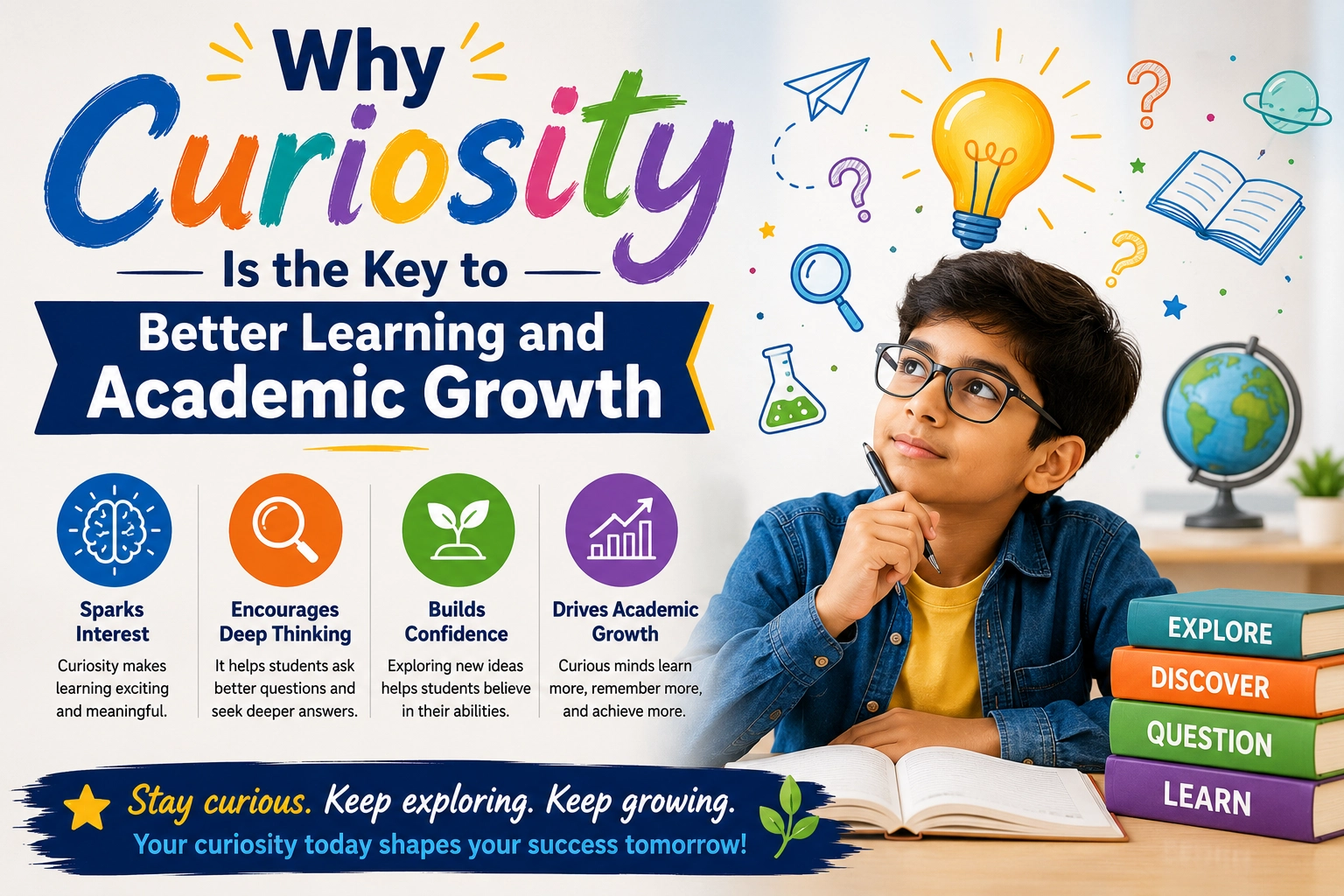
Curiosity is the key to better learning and academic growth because it changes everything about how a student engages with their education — how deeply they process new information, how persistently they pursue understanding, how creatively they approach problems, and how willingly they continue learning when the external requirement to do so is removed.
It is not a passive quality that some students happen to possess. It is an active orientation that schools and families can deliberately cultivate — through the environments they create, the questions they model, and the value they place on wondering as much as knowing. The academic growth that follows is real, measurable, and lasting.
Frequently Asked Questions
Q1. Can curiosity be taught, or is it something children either have or don't have?
Curiosity is primarily developed through environment and experience rather than being a fixed innate trait. All young children demonstrate high curiosity — the developmental challenge is sustaining and deepening it as children move through school. Environments that welcome questions, reward intellectual risk-taking, and treat not-knowing as an opportunity rather than a failure consistently produce more curious learners than those oriented primarily around performance and correct answers.
Q2. My child asks lots of questions at home but is very quiet in class. Why might that be?
This is a common pattern and almost always reflects the classroom environment rather than the child’s natural disposition. Children who are highly inquisitive at home but quiet in class have typically learned — consciously or otherwise — that asking questions in that particular classroom carries social or academic risk. This might be because incorrect answers are met with negative reactions, because questions are treated as interruptions, or simply because the classroom culture does not actively invite student inquiry. Speaking with the class teacher about this pattern is often a useful starting point.
Q3. How does curiosity relate to creativity?
Curiosity and creativity are deeply intertwined. Creativity is largely the product of unusual connections between existing pieces of knowledge — connections that are most likely to be made by minds that have ranged widely and wondered actively. The most creative thinkers across every field — science, arts, business, design — are consistently characterised by intense curiosity about domains beyond their primary expertise. Developing curiosity in students is therefore also developing the foundation of creative thinking.
Q4. Does an emphasis on curiosity come at the expense of academic rigour?
No — and this is one of the most important misconceptions to address. Curiosity-driven learning and academic rigour are not in tension; they are mutually reinforcing. The student who is genuinely curious about a topic engages more deeply, retains more effectively, and develops more flexible, applicable understanding than the student who covers the same material passively. The research evidence on this is consistent and strong. Schools that prioritise both produce students who are more academically capable, not less.
Q5. What practical steps can teachers take to increase curiosity in the classroom?
The most impactful steps are cultural rather than curricular: modelling genuine wonder, creating consistent space for student questions, extending wait time after posing questions (even three to five seconds dramatically improves the quality of student responses), responding to unexpected questions with interest rather than redirection, and designing assessments that reward reasoning and inquiry alongside correct answers. Physical environment also matters — classrooms that display unanswered questions, works in progress, and student-generated investigations communicate that curiosity is a valued part of the learning community.