
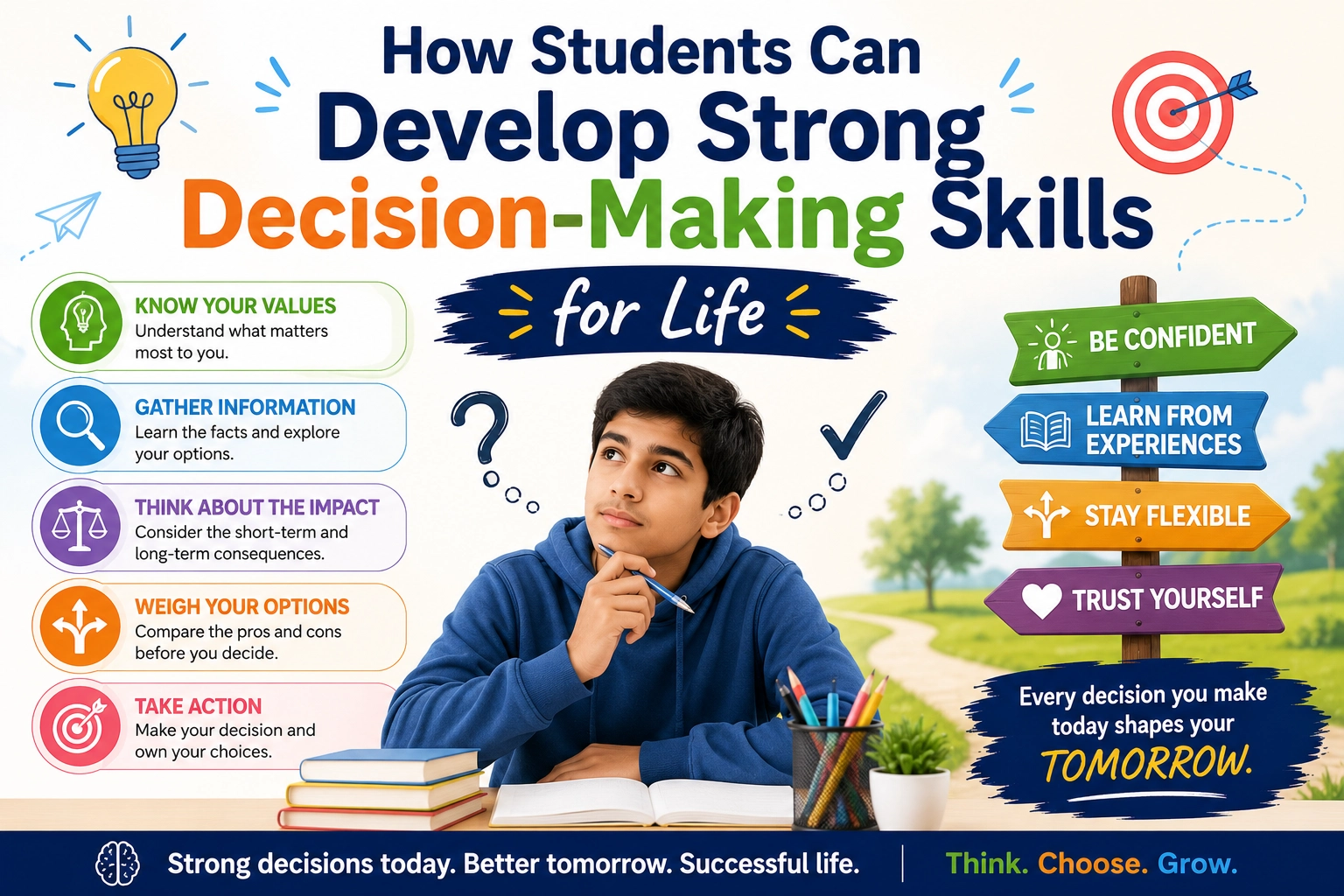
From the moment a student walks into school each morning to the moment they go to bed at night, they are making decisions. Some are trivial — which seat to choose, what to eat for lunch. Others carry genuine weight — whether to ask for help with a subject they are struggling with, how to respond when a friend is being treated unfairly, whether to prioritise sleep or finish an assignment.
Decision-making is one of the most used skills in daily life and one of the least explicitly taught in schools. Most students develop their approach to decisions through trial, error, and the absorbed habits of the adults around them — which means the quality of their decision-making is largely a product of circumstance rather than deliberate development.
This matters because decision-making is a learnable skill. Like reading or mathematics, it responds to direct instruction, deliberate practice, and thoughtful feedback. Students who learn to make decisions well — to think clearly about options, consequences, and values — carry that capability into every domain of their lives.
What Good Decision-Making Actually Involves
Before looking at how students can develop decision-making skills, it is worth being precise about what those skills actually are. Good decision-making is not simply the ability to choose correctly — outcomes are often influenced by factors outside anyone’s control. It is the ability to approach decisions with a reliable process that maximises the likelihood of sound choices.
That process involves several interconnected capabilities:
Defining the Decision Clearly
Many poor decisions are the result of unclear thinking about what decision is actually being made. A student who is anxious about ‘school’ is not yet in a position to make any useful decision. A student who identifies ‘I need to decide whether to ask my teacher for extra help with this topic before the assessment’ has defined a specific decision that can be thought through methodically.
The habit of naming and defining decisions precisely — rather than carrying a diffuse sense of overwhelm — is foundational to everything that follows in the decision-making process.
Considering Multiple Options
One of the most reliable failures in student decision-making is binary thinking — the assumption that only two options exist, usually the obvious choice and its opposite. Effective decision-makers consistently ask: ‘What else is possible?’ Often, the most useful option is the third or fourth one, only visible after the first two have been examined and found wanting.
Students can practise this explicitly by setting a rule for themselves: before committing to any significant decision, identify at least three options, even if the third seems unlikely. The exercise of generating a third option develops cognitive flexibility that improves decision quality across all contexts.
Thinking Through Consequences
Good decisions require honest, forward-looking thinking: if I choose this, what is likely to happen — immediately, in a week, in a month? This is not about anxiety or over-analysis. It is about briefly and deliberately imagining the likely downstream effects of each option before committing to one.
This skill requires practice because the natural cognitive tendency — particularly in adolescents, whose prefrontal cortex is still developing — is to weight immediate consequences more heavily than delayed ones. Deliberately practising consequence-thinking counteracts this bias over time.
Managing Emotion in the Decision
Emotions are not obstacles to good decision-making — they are important sources of information about what matters to us. But emotional intensity at the moment of decision can distort that information and produce impulsive choices that the calmer, more reflective self would not endorse.
The most effective technique for managing this is simple: create a gap. A brief pause — even taking a slow breath before responding to a message, or sleeping on a significant decision before acting — allows the rational prefrontal cortex to engage and moderate the emotional response. This pause is one of the simplest and most powerful decision-making tools available.
Reflecting on Past Decisions
Decision-making improves through honest reflection. Students who periodically review their recent decisions — what they chose, what happened, what they would do differently with hindsight — build a growing library of personal experience that progressively sharpens their judgment. This habit of reflective review is one of the clearest distinguishing features of people who make consistently good decisions over time.
The Domains of Student Decision-Making
Students face decision-making challenges across several distinct domains, each with its own particular pressures and required skills.
Academic Decisions
How to allocate study time across subjects. Whether to ask for help or attempt a problem independently. Whether to prioritise depth of understanding or breadth of coverage before an assessment. These decisions, made hundreds of times across a school career, compound into significant differences in academic outcomes.
Students who make deliberately better academic decisions — who are honest about what they do and do not understand, who prioritise effectively rather than defaulting to what is most comfortable, who seek help early rather than late — develop not just better results but better learning habits.
Social Decisions
How to respond when a friend behaves hurtfully. Whether to go along with peer pressure or hold a different position. How to include others or seek inclusion in group settings. How to communicate digitally in ways that build rather than damage relationships.
Social decisions are among the most emotionally charged decisions students face, which means the emotion-management component of good decision-making is particularly important in this domain. Students who can pause, consider the perspective of others, and think beyond the immediate moment tend to navigate social complexity significantly more effectively.
Parents in Bengaluru who are evaluating schools for their children often look for institutions that develop social and emotional skills alongside academic ones. Among ICSE schools in Bangalore, those with strong pastoral care programmes, mentoring systems, and explicit social-emotional learning are best placed to develop the full range of decision-making capabilities students need for life.
Personal and Lifestyle Decisions
How to balance schoolwork, co-curricular activities, and rest. Whether to take on a new challenge or play it safe. How to manage money, time, and energy as they grow into greater independence. These decisions become progressively more consequential as students move through adolescence.
Students who have been given genuine, age-appropriate decision-making practice earlier in their school lives — who have been allowed to make real choices and live with real (low-stakes) consequences — are significantly better equipped to handle the larger decisions that increasing independence brings.
Practical Strategies for Developing Decision-Making Skills
The Decision Journal
Encourage students to keep a simple decision journal — a notebook or digital document where they record one or two significant decisions each week: what the decision was, what options they considered, what they chose, and (after enough time has passed) what happened. Reviewing this journal periodically builds exactly the reflective pattern that improves decision quality over time.
The journal does not need to be elaborate. Even three or four sentences per decision, reviewed monthly, creates a meaningful pattern of reflective practice that most students would not otherwise engage in.
The Pre-Mortem Technique
Before making a significant decision, ask: ‘If I make this choice and it goes badly wrong, what is most likely to have gone wrong?’ This technique — adapted from project management practice — is a remarkably effective way of identifying the weakest points in a planned decision before committing to it. Students who regularly use a version of this question develop a natural habit of anticipating risks without becoming paralysed by them.
Practise Decision-Making in Low-Stakes Situations
The most effective way to develop any skill is through deliberate practice. Decision-making is no exception. Parents who give children genuine choices — about how to spend free time, what to cook for dinner, how to resolve a minor family disagreement — provide exactly the low-stakes practice environment in which decision-making habits form.
The crucial element is allowing consequences to follow choices. A child who chooses to spend their free time on screens and then has nothing to do in the evening is learning something real about the relationship between decisions and outcomes. A parent who rescues the child from that consequence removes the learning.
The best learning environments provide structured opportunities for students to make and reflect on genuine decisions. Among best schools in Bangalore that are known for developing student leadership and agency, those with student councils, project-based learning programmes, and self-directed inquiry components provide exactly this kind of decision-making practice within a supported school context.
Explicitly Teach the Decision-Making Process
Schools that teach decision-making explicitly — introducing frameworks, providing structured practice, and reviewing outcomes — produce students who make better decisions than those that leave the skill to develop incidentally. Simple, age-appropriate frameworks such as ‘Define, Options, Consequences, Choose, Review’ give students a cognitive scaffold that they can apply independently across any decision context.
The Role of Emotional Intelligence in Decision-Making
Decision-making and emotional intelligence are not separate capacities. They operate together in every significant choice a student makes. A student who cannot identify their own emotional state accurately is likely to make decisions that feel right in the moment but reflect emotional reactivity rather than genuine judgment. A student who lacks empathy is likely to make decisions that damage relationships without understanding why.
The emotional intelligence skills most directly relevant to decision-making are self-awareness (knowing what you are feeling and why), self-regulation (managing emotional intensity so it does not override rational judgment), and perspective-taking (genuinely considering how a decision will affect others). Students who develop these three capabilities alongside the cognitive components of decision-making are substantially better equipped for the real complexity of life decisions.
Parents comparing educational options for their children and looking specifically at top ICSE schools in Bangalore who ask about social-emotional learning and pastoral care will find that schools with formal advisory systems, mentoring programmes, and explicit wellbeing curricula are investing in the emotional foundations that make good decision-making possible.
How Parents Can Support Decision-Making Development
The family home is where the deepest decision-making habits are formed. Parents shape these habits not primarily through what they say about decision-making but through how they model it and what they allow their children to experience.
- Share your own decision-making process — when you face a real decision, think aloud about how you are approaching it. This models the cognitive process directly.
- Ask questions rather than giving answers — when your child faces a decision, resist the immediate urge to tell them what to do. Ask ‘What are your options?’ and ‘What do you think might happen if you choose that?’
- Allow natural consequences — in low-stakes situations, let decisions play out without rescue. The experience of a poor outcome is often the most effective teacher.
- Debrief after significant decisions — once enough time has passed, revisit important decisions together: ‘How did that work out? What would you do differently?’
- Communicate your values clearly — good decisions are anchored in clear values. Children who understand what their family stands for and why have a framework that supports decision-making across all domains.
Conclusion
Strong decision-making skills for life do not develop automatically. They require deliberate cultivation — through direct teaching, structured practice, honest reflection, and the kind of supportive environment that allows students to make real choices and learn from real outcomes.
Students who develop these skills carry a capability that serves them in every domain of life — in their academic choices, their friendships, their careers, and their personal development. The investment in teaching decision-making well is, in the most literal sense, an investment in the quality of the life students will go on to lead. Schools and families that take this seriously are giving students something that marks, grades, and certificates cannot fully capture: the capacity to navigate complexity with clarity, confidence, and genuine judgment.
Frequently Asked Questions
Q1. At what age should children begin learning decision-making skills?
Decision-making practice should begin in early childhood. Even three and four-year-olds can be offered genuine choices and supported to experience the consequences. As children grow, the complexity and stakes of practice decisions should scale accordingly — from choosing how to spend free time in primary school to making meaningful contributions to family decisions in secondary school. The earlier the practice begins, the more naturally good decision-making habits become embedded in a child’s cognitive repertoire.
Q2. My child always defers to others and cannot seem to make decisions independently. What can help?
Habitual deference in decision-making often reflects either a fear of being wrong or a lack of confidence in one’s own judgment — both of which are addressable. Start with very low-stakes decisions where there is no wrong answer and where the child’s preference is the only relevant consideration. Celebrate the act of deciding, regardless of the outcome. Gradually increase the complexity of decisions the child is asked to make independently, ensuring that each experience of deciding and living with the outcome builds rather than undermines confidence.
Q3. How can teachers build decision-making practice into regular classroom activities?
There are many natural opportunities: asking students to design their own approaches to a project before prescribing a method; using structured debate and discussion to practise arguing for and against positions; running classroom simulations that require students to make choices under constraint; incorporating regular reflection exercises that ask students to review choices they have made in their academic work. The key is creating genuine choice where the student’s decision actually matters — not pseudo-choice where all options lead to the same outcome.
Q4. Is decision-making affected by the academic pressure students are under?
Yes — significantly. High academic pressure tends to narrow decision-making by activating the stress response in ways that reduce access to the prefrontal cortex, the brain region most involved in deliberate, rational decision-making. Under acute stress, students are more likely to make impulsive, reactive choices or to freeze and avoid deciding altogether. This is one reason why stress management and decision-making development are not separate educational priorities — they reinforce each other directly.
Q5. What is the biggest mistake parents make when trying to help their children make better decisions?
The most common and consequential mistake is making the decision for the child — either directly, by telling them what to do, or indirectly, by rescuing them from the consequences of their own choices so thoroughly that no real learning occurs. Good intentions drive this pattern: parents want to protect children from poor outcomes. But protecting children from the consequences of their own decisions consistently and comprehensively prevents the development of the very capability that would allow them to make better decisions independently in the future.